
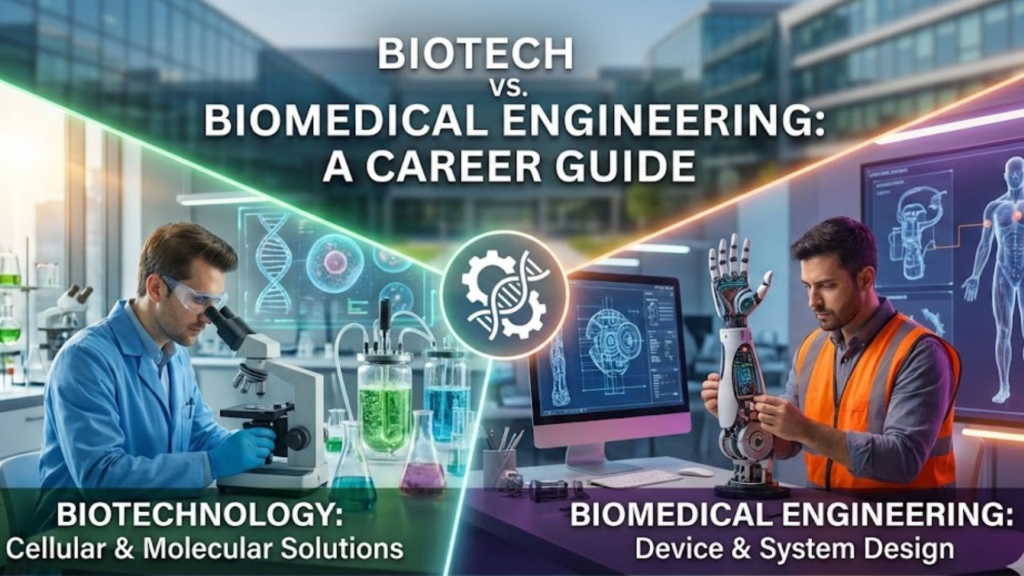
As the healthcare industry undergoes a digital and biological revolution, two interdisciplinary fields have emerged as the frontrunners of innovation: Biotechnology and Biomedical Engineering.
While both fields aim to solve complex medical challenges, they offer distinct paths for students and professionals. If you’re looking to build a career at the intersection of science and technology, understanding these differences is crucial for choosing the right degree.
1. The Core Difference: Molecules vs. Machines
At its heart, the difference lies in the approach to problem-solving:
-
Biotechnology focuses on the manipulation of living systems. It works at the cellular and molecular levels. Think of “biotech” as the science of using biology to create products—like developing a new vaccine, engineering drought-resistant crops, or using CRISPR for gene therapy.
-
Biomedical Engineering (BME) focuses on applying engineering principles to medicine. BME is about the “hardware” and “software” of healthcare. It involves designing tangible technologies like prosthetic limbs, MRI scanners, artificial heart valves, and AI-driven diagnostic tools.
2. Academic Focus & Skill Sets
Choosing between the two often comes down to your academic strengths and interests:
-
The Biotech Path: If you are passionate about Biology and Chemistry, this is for you. You will study microbiology, genetics, biochemistry, and molecular biology. The work is largely lab-based, focusing on experiments, DNA sequencing, and fermentation.
-
The Biomedical Path: If you enjoy Physics, Mathematics, and Design, BME is the better fit. Your curriculum will integrate mechanical or electrical engineering with human anatomy. You’ll learn about biomaterials, biomechanics, and medical instrumentation.
3. Career Outlook: Where are the Jobs?
Both fields are seeing a surge in demand, but the “end-user” and work environments differ significantly.
Biotechnology Career Paths
Biotech graduates primarily find roles in Research & Development (R&D) and the Pharmaceutical sector.
-
Top Roles: Research Scientist, Molecular Biologist, Clinical Research Associate (CRA), Bioprocess Engineer, Quality Control Analyst.
-
Top Industries: Pharma companies (like Pfizer or Biocon), Agritech firms, Vaccine manufacturers, and Environmental agencies.
Biomedical Engineering Career Paths
BME graduates often work at the interface of technology and patient care.
-
Top Roles: Medical Device Designer, Clinical Engineer, Rehabilitation Engineer, Regulatory Affairs Specialist, AI-Healthcare Specialist.
-
Top Industries: MedTech giants (like Siemens Healthineers or GE Healthcare), Hospitals, and startups focused on wearable tech or robotics.
4. Which One Should You Choose?
The decision should align with where you see yourself working daily:
| Feature | Biotechnology | Biomedical Engineering |
| Primary Focus | Living organisms & biological processes | Engineering design & medical devices |
| Work Environment | Laboratory / Research Centers | Hospitals / Manufacturing / Tech Labs |
| Key Subjects | Genetics, Microbiology, Biochemistry | Maths, Physics, Circuitry, Mechanics |
| End Goal | Creating biological solutions (drugs/seeds) | Creating physical solutions (tools/systems) |
The Verdict
There is no “better” degree; there is only the “better fit” for your goals.
If you want to decode the mysteries of DNA and develop the next generation of life-saving drugs, Biotechnology is your calling. However, if you are driven by the idea of building the next robotic surgical arm or a smarter heart monitor, Biomedical Engineering will provide the tools to build that future.
Source: https://timesofindia.indiatimes.com/